

ECO-FRIENDLY CLEANING STANDARDS IN 2026: THE DEFINITIVE GUIDE TO NON-TOXIC HOME CARE
Establishing the new benchmark for health-conscious, premium residential maintenance
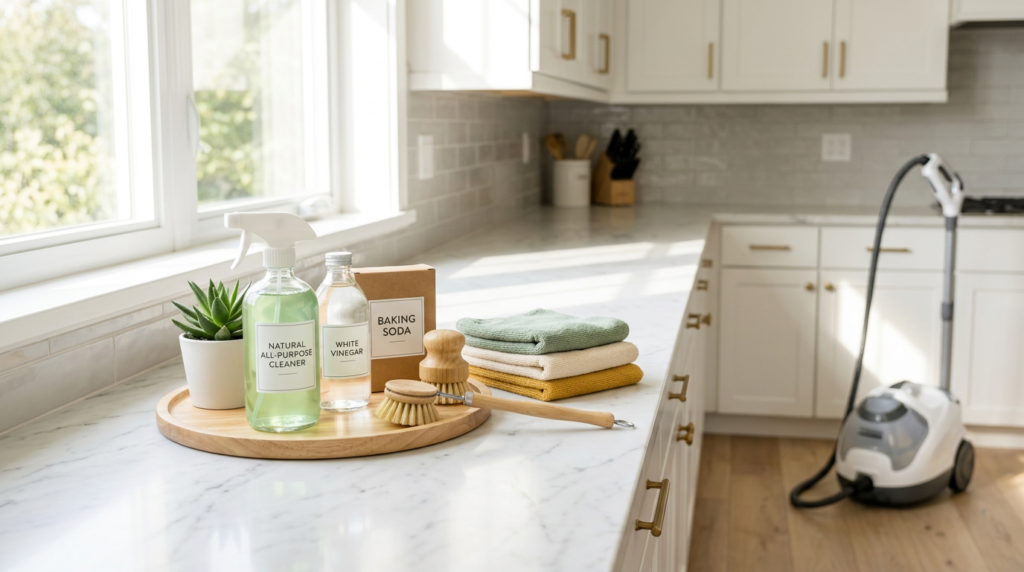
Eco-Friendly Cleaning Standards in 2026: The Definitive Guide to Non-Toxic Home Care
1. Introduction
The evolution of residential maintenance has reached a critical turning point. In 2026, the definition of “clean” has undergone a profound transformation; it no longer signifies the sharp, clinical scent of bleach or the aggressive, chemical foam of industrial-grade detergents. A new standard has emerged—one that measures cleanliness not by the intensity of a synthetic fragrance, but by the absolute absence of toxicity. Modern homeowners, particularly high-performing professionals and health-conscious families, are increasingly aware that conventional cleaning products often leave behind invisible residues. These volatile organic compounds (VOCs) and chemical films do more than just sit on surfaces; they actively degrade indoor air quality, trigger skin sensitivities, and contribute to long-term environmental degradation.
This guide establishes the definitive eco-friendly cleaning standards for premium homes in 2026. We move beyond the superficial marketing of “green” products to explore the rigorous certifications, the specific ingredients that must be eliminated from your sanctuary, and the professional-grade natural alternatives that deliver five-star results. By adopting these protocols, you ensure that your home remains a safe haven that supports your health and productivity without compromising the ecological integrity of the planet. True luxury in the modern home is now defined by the purity of the environment we inhabit.
2. What Does “Eco-Friendly” Really Mean in 2026?
As the market for sustainable products has expanded, so has the prevalence of “greenwashing”—the deceptive practice of using vague terminology to imply environmental responsibility. In 2026, discerning homeowners must look past aesthetic packaging and focus on verifiable data and third-party oversight.
2.1 Beyond Greenwashing: Real Certifications That Matter
Terms like “natural,” “earth-friendly,” or “botanical” are largely unregulated and can be used on products that still contain significant irritants. To ensure a product meets the 2026 eco-friendly cleaning standards, look for the following legitimate certifications:
- EPA Safer Choice: Managed by the U.
S. Environmental Protection Agency, this label ensures every ingredient has been vetted for human health and environmental safety.
- Green Seal: A non-profit certification that evaluates the entire lifecycle of a product, from raw material extraction to performance and packaging.
- EcoLogo: Part of UL Solutions, this certifies products that meet stringent environmental performance standards throughout their lifecycle.
- Leaping Bunny: The gold standard for cruelty-free products, ensuring no animal testing was involved at any stage of formulation.
- USDA Certified Biobased: Indicates the percentage of renewable biological ingredients, reducing reliance on petroleum-based chemicals.
- Cradle to Cradle: A multi-attribute certification that assesses material health, product circularity, air quality, and social fairness.
2.2 Ingredients to Eliminate From Your Home
Achieving a non-toxic home requires a proactive “black list” of ingredients. Many conventional cleaners contain substances that act as endocrine disruptors or respiratory irritants. The following offenders should be removed from your inventory immediately:
- Phthalates: Often hidden under the term “fragrance,” these are linked to hormonal imbalances and reproductive issues.
- Quaternary Ammonium Compounds (Quats): Found in many disinfectants and fabric softeners, these are potent skin irritants and have been linked to respiratory issues like asthma.
- Chlorine Bleach: A harsh corrosive that can damage lung tissue and create toxic organochlorines when released into the environment.
- Ammonia: A volatile chemical that can trigger chronic bronchitis and irritate the eyes and throat.
- 2-Butoxyethanol: Commonly found in window cleaners, this solvent can cause sore throats and, at high levels, contribute to liver and kidney damage.
- Sodium Hydroxide: Also known as lye, it is highly caustic and found in oven and drain cleaners.
- Formaldehyde-releasing Preservatives: Used to extend shelf life, these slowly release a known carcinogen into your indoor air.
For a deeper dive into building a safe inventory, refer to our Ultimate Guide to Sustainable and Non-Toxic Cleaning 2026, which provides a comprehensive breakdown of safe chemical alternatives.
3. The Professional Eco-Friendly Cleaning Arsenal
Modern technology has provided us with tools that outperform traditional chemicals. The 2026 toolkit relies on physics and biology rather than harsh chemistry.
3.1 The Power of Steam Sanitization
Steam cleaning is the cornerstone of the non-toxic movement. By using only pressurized water heated above 200°F (93°C), steam kills 99.9% of bacteria, viruses, and dust mites. It is an unparalleled method for sanitizing bathroom tile, grout, kitchen backsplashes, and even upholstery without leaving a single molecule of chemical residue. For premium homes, we recommend a dual-setup: a handheld steamer for rapid kitchen touch-ups and a high-capacity canister steamer for deep-cleaning floors and large surfaces.
3.2 Probiotic Cleaners — The Science of Good Bacteria
Unlike traditional disinfectants that “nuke” all bacteria—including the beneficial microbes that protect our environment—probiotic cleaners utilize beneficial bacteria (specifically *Bacillus* species). These microbes consume organic matter, grease, and soap scum at a microscopic level. More importantly, they leave behind a “living” protective layer that continues to work for days, preventing the regrowth of harmful pathogens. This approach aligns with the principles discussed in The Science of a Healthy Home, where we explore how a balanced indoor microbiome supports mental clarity and physical health.
3.3 Essential Plant-Based Concentrates
A professional-grade result can often be achieved with a few versatile, high-purity concentrates. These form the basis of the most effective DIY solutions:
- White Vinegar: Excellent for glass, mirrors, and neutralizing odors.
- Citric Acid: The gold standard for descaling coffee makers and removing hard water stains from fixtures.
- Baking Soda: Provides gentle abrasion for sinks and tubs without scratching.
- Castile Soap: A vegetable-based soap that serves as an all-purpose cleaner when diluted.
- Hydrogen Peroxide (3%): A safe, biodegradable alternative to bleach for disinfection and whitening.
- Isopropyl Alcohol (70%): Ideal for sanitizing high-touch electronics and stainless steel.
3.4 The Microfiber Revolution
Not all cloths are created equal. High-quality microfiber (with a denier of 0.3 or less) is engineered to trap and remove up to 99% of bacteria using only water through electrostatic attraction. To prevent cross-contamination, adopt a professional color-coding system: **Blue** for glass and polishing, **Yellow** for bathrooms, **Green** for the kitchen, and **Red** for high-risk sanitary areas.
4. The 2026 Eco-Friendly Cleaning Protocol by Room
4.1 Kitchen — Grease Meets Green
Kitchen grease is notoriously difficult to manage without heavy degreasers. The 2026 protocol involves using steam to liquefy grease, followed by a probiotic spray to break down any remaining lipids. For ovens, avoid caustic sprays; instead, apply a paste of baking soda and water, let it sit overnight, and wipe away the grime with a vinegar rinse. Cutting boards should be sanitized with 3% hydrogen peroxide to eliminate food-borne pathogens without contaminating future meals.
4.2 Bathrooms — Mold and Mildew Without Bleach
Mold thrives in the porous surfaces of grout. While bleach only whitens the surface, steam penetrates deep into the pores to kill the mold at the root. Use a vinegar-based solution for shower glass to prevent the buildup of calcium and magnesium. **Important Note:** Never use vinegar or acidic cleaners on natural stone like marble or granite, as it will etch the surface. Use a pH-neutral stone cleaner for these premium materials.
4.3 Living Areas — Dust Control for Respiratory Health
Traditional dusting often just moves particles into the air. Use damp microfiber mopping to capture dust effectively. Ensure your vacuum is equipped with a certified HEPA filter to prevent fine allergens from being exhausted back into the room. For laundry, replace synthetic dryer sheets with wool dryer balls to reduce drying time and eliminate the need for phthalate-heavy fragrances.
4.4 Bedrooms — Creating a Truly Clean Sleep Sanctuary
Your bedroom should be the purest room in the house. Clean your mattress quarterly by vacuuming with a HEPA-equipped machine and spot-treating with a mixture of hydrogen peroxide and Castile soap. Avoid “dry cleaning” curtains or bedding with perchloroethylene; instead, seek out water-based, eco-friendly professional cleaners or use home steam sanitization to refresh fabrics safely.
5. The Economic Case for Eco-Friendly Cleaning
There is a persistent myth that “going green” is an expensive luxury. In reality, the economic data for 2026 suggests otherwise. A high-quality plant-based concentrate typically costs approximately **$0.15 per use** when diluted, compared to **$0.35–$0.50** for conventional brand-name sprays. Furthermore, an investment in a professional-grade steam cleaner often pays for itself within six months by eliminating the need for disposable wipes, specialized chemical sprays, and paper towels. Beyond direct costs, a non-toxic home environment significantly reduces long-term healthcare expenditures related to chronic asthma, allergies, and chemical sensitivities.
6. The Eco-Friendly Cleaning Schedule
Consistency is the key to maintaining a premium home. This schedule integrates seamlessly with our 15-minute daily cleaning routine:
- Daily: Apply a probiotic surface spray to high-touch areas and wipe with a color-coded microfiber cloth.
- Weekly: Perform a steam sanitization of kitchen counters and bathroom fixtures.
- Monthly: Descale appliances (coffee makers, dishwashers) using citric acid and deep-clean the oven with baking soda.
- Seasonally: Conduct a full-home steam sanitization, replace HEPA filters, and schedule professional eco-friendly carpet extraction.
7. Common Myths About Eco-Friendly Cleaning
To fully adopt these standards, we must dispel the misinformation that lingers from the early days of the green movement:
- Myth 1: “Natural cleaners don’t disinfect.” — Fact: Steam at temperatures above 200°F and 3% hydrogen peroxide are both EPA-registered methods for killing pathogens, including viruses.
- Myth 2: “Vinegar cleans everything.” — Fact: Vinegar is a powerful acid. It can damage rubber seals in dishwashers, etch natural stone, and strip the finish off certain hardwoods.
- Myth 3: “Eco-friendly is more expensive.” — Fact: As noted in our economic analysis, DIY solutions and concentrates are significantly cheaper over a 12-month period than single-purpose commercial products.
- Myth 4: “It smells like a salad.” — Fact: Modern eco-cleaning relies on unscented bases or high-quality essential oils. As we discuss in our guide on Mastering Indoor Air Quality, the absence of any fragrance is the ultimate sign of a truly clean home.
8. When to Call a Professional Eco-Cleaning Service
While daily and weekly maintenance can be handled internally, certain tasks require industrial-grade eco-technology. Deep carpet extraction, air duct cleaning with HEPA-filtered negative pressure, and upholstery cleaning for delicate silks or velvets should be handled by specialists. When vetting a service, ask for their specific eco-certifications and a full list of the products they bring into your home. A truly professional service will be transparent about their material safety data sheets (MSDS).
The eco-friendly cleaning standards of 2026 are not a sacrifice; they are a significant upgrade to your quality of life. By choosing non-toxic methods, you are not merely cleaning your home—you are making a strategic investment in your long-term health, your family’s safety, and the future of the environment. The technology available today allows us to achieve professional, five-star results using nothing more than plant-based chemistry, the power of steam, and intelligent protocols. Start by replacing one conventional product at a time, and you will soon experience the profound difference of living in a truly clean, sparkling home.
About the Author: Pedro Neto is a freelancer and an enthusiast of practical daily solutions. With a keen eye for efficiency and organization, Pedro shares on sparklinghomecare.com the best strategies and techniques to transform the home care routine into something simple, fast, and high-impact.
Disclaimer: This article provides general guidance on eco-friendly cleaning. Always test any product or method on a small, hidden, inconspicuous area before full application. The use of natural substances is the responsibility of the user. Consult manufacturer instructions for your specific surfaces and appliances.