
NATURAL VS. CHEMICAL CLEANERS: WHAT SCIENCE ACTUALLY SAYS ABOUT SAFETY AND EFFECTIVENESS
An evidence-based analysis of household sanitation, toxicity, and performance
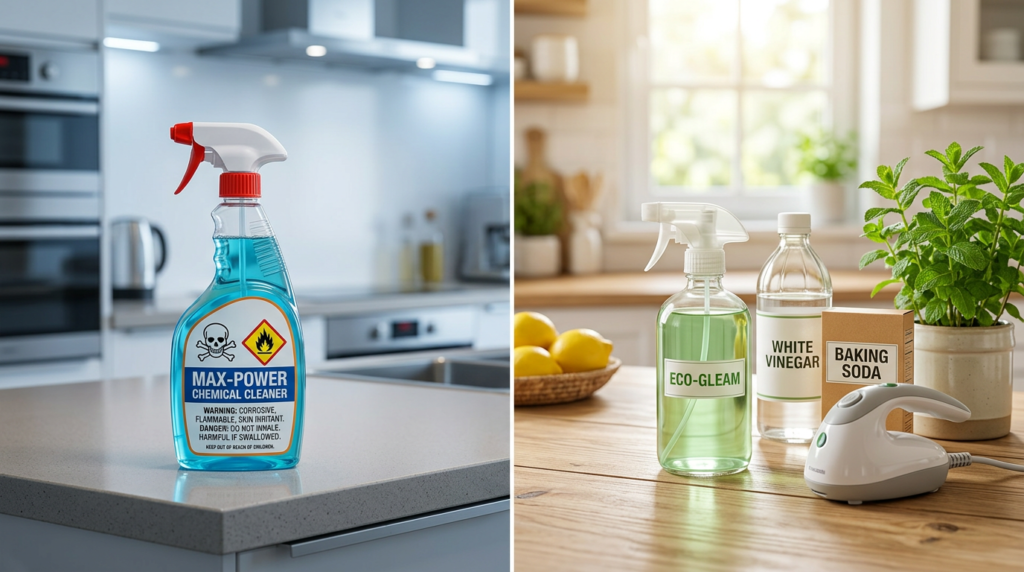
Natural vs. Chemical Cleaners: What Science Actually Says About Safety and Effectiveness
1. Introduction
The cleaning aisle has become a battlefield. On one side, conventional products promise superior germ-killing power with clinical precision. On the other, natural alternatives claim to protect your health and the planet. Consumers are caught in the crossfire of marketing claims, with each side accusing the other of being ineffective or dangerous. The truth is more nuanced than either camp admits. This article cuts through the marketing noise by examining what peer-reviewed science actually says about the safety and effectiveness of natural versus chemical cleaning methods. We will evaluate disinfectant efficacy, human toxicity, environmental impact, cost, and real-world performance. By the end, you will have the evidence you need to make informed decisions about the products you bring into your home — without the dogma or the fear-mongering.
2. How We Evaluated the Evidence
To provide a balanced perspective, this comparison is based on a rigorous review of peer-reviewed studies from environmental health journals, EPA registration data, and toxicology databases such as PubChem and the National Institutes of Health (NIH). We also analyzed clinical studies regarding respiratory health and environmental impact assessments. Our evaluation focuses on the most common household cleaning scenarios: kitchen sanitation, bathroom disinfection, general surface cleaning, and laundry. By prioritizing data over anecdotes, we aim to clarify where chemical power is essential and where natural solutions offer a superior safety-to-performance ratio.
3. The Case for Chemical Cleaners — What Science Supports
3.1. Disinfection Efficacy
Conventional disinfectants, including bleach, quaternary ammonium compounds (quats), and commercial hydrogen peroxide-based products, are rigorously tested and EPA-registered. They undergo standardized testing via AOAC International methods to verify kill rates for specific pathogens. Sodium hypochlorite (bleach) at recommended dilutions is scientifically proven to kill 99.9% of bacteria, viruses, and fungi within a contact time of 30 seconds to 10 minutes. Quaternary ammonium compounds are highly effective against enveloped viruses and bacteria, though they show less efficacy against non-enveloped viruses and bacterial spores. The primary scientific advantage of these chemicals is their predictable, standardized performance under established protocols.
3.2. Shelf Stability and Convenience
Conventional cleaners are engineered for long-term stability. A standard bottle of bleach-based cleaner typically maintains its efficacy for 6 to 12 months when stored correctly. In contrast, many natural alternatives, particularly those utilizing active enzymes or probiotic bacteria, have significantly shorter shelf lives and require specific storage conditions to remain active. For households that clean infrequently or require “ready-to-go” solutions for emergencies, conventional products offer more reliable long-term performance without the risk of ingredient degradation.
3.3. Regulatory Oversight
Commercial disinfectants must be EPA-registered, a process requiring manufacturers to submit extensive efficacy data, toxicity profiles, and precise labeling instructions. While natural products marketed as “disinfectants” must meet these same standards, many natural brands avoid this label to bypass strict regulatory hurdles. Instead, they use terms like “sanitizer” or “cleaner,” which are subject to different regulatory requirements and often lower standards of proof regarding their ability to eliminate specific pathogens.
4. The Case Against Chemical Cleaners — What Science Warns
4.1. Respiratory Health Risks
The strongest body of evidence against conventional cleaners concerns respiratory health. A landmark study published in the American Journal of Respiratory and Critical Care Medicine (2018) followed over 6,000 participants for 20 years. The findings were startling: women who worked as cleaners or used cleaning sprays regularly experienced an accelerated decline in lung function comparable to smoking a pack of cigarettes a day for two decades. The primary culprits identified were quaternary ammonium compounds and bleach. Further research has consistently linked frequent bleach exposure to an increased risk of Chronic Obstructive Pulmonary Disease (COPD) and asthma exacerbation, particularly in children.
4.2. Endocrine Disruption
Several common cleaning chemicals are known or suspected endocrine disruptors. Phthalates, often hidden under the term “fragrance,” have been linked in peer-reviewed literature to reduced sperm quality and reproductive hormone disruption. Alkylphenols, used in various detergents, can mimic estrogen in the body. The scientific evidence regarding endocrine disruption is robust enough that the European Union has banned or strictly restricted several of these compounds. However, they remain prevalent in many international markets, including the United States, posing a silent risk to long-term hormonal health.
4.3. Environmental Persistence
Quaternary ammonium compounds (quats) are notoriously persistent in aquatic environments. Studies show they are toxic to fish and aquatic invertebrates even at low concentrations. Furthermore, phosphates—though reduced in many areas—still appear in some dishwasher detergents, contributing to algal blooms and the eutrophication of waterways. Beyond the chemistry, the delivery systems for conventional cleaners contribute significantly to the global plastic waste crisis, as most are sold in single-use plastic bottles designed for immediate disposal.
5. The Case for Natural Cleaners — What Science Supports
5.1. Safety Profile
The evidence strongly supports that plant-based, enzyme-based, and mineral-based cleaners have significantly lower acute toxicity than conventional alternatives. The LD50 (lethal dose) of typical natural ingredients—such as citric acid, baking soda, and vinegar—is orders of magnitude higher than that of bleach or ammonia. For households with small children, pets, or individuals with chemical sensitivities, natural cleaners present a minimal risk of accidental poisoning or severe skin and respiratory irritation, making them the scientifically safer choice for daily maintenance.
5.2. Indoor Air Quality
Switching to natural cleaners measurably improves indoor air quality, a critical factor for modern homes. A study published in Environmental Science and Technology found that replacing conventional cleaners with fragrance-free natural alternatives reduced indoor Volatile Organic Compound (VOC) levels by 50% to 80%. This has direct implications for cognitive health; research from the Harvard T.
H. Chan School of Public Health demonstrated that higher indoor VOC levels correlate with reduced cognitive performance on complex decision-making tasks. Maintaining a low-VOC environment is essential for long-term wellness, as detailed in our guide on how to master indoor air quality in premium homes.
5.3. Environmental Biodegradability
Ingredients found in natural cleaners, such as plant-derived surfactants, essential oils, and enzymes, are typically biodegradable within days or weeks. They do not accumulate in ecosystems or persist in the water table. Furthermore, many natural brands prioritize concentrated formulas, which significantly reduce the carbon footprint associated with packaging and transportation. This alignment with eco-friendly cleaning standards ensures that the home remains clean without compromising the health of the broader environment.
6. The Case Against Natural Cleaners — What the Evidence Shows
6.1. Variable Disinfection Efficacy
The most significant scientific limitation of natural cleaners is their variable efficacy in disinfection. While undiluted white vinegar (5% acetic acid) possesses antimicrobial properties, studies show it requires contact times of 30 minutes or more to achieve significant bacterial reduction—a stark contrast to the 30-second window of bleach. Baking soda has virtually no antimicrobial activity; its utility is mechanical, serving as an abrasive. While essential oils like tea tree or thyme show promise in lab settings, their effectiveness at safe, non-irritating concentrations in a home environment is often insufficient for high-risk pathogens.
6.2. Risk of DIY Formulation Errors
The trend of “Do-It-Yourself” cleaners often ignores basic chemistry. Mixing vinegar (an acid) with baking soda (a base) creates a chemical reaction that produces carbon dioxide and salt water, effectively neutralizing the cleaning properties of both. More dangerously, mixing vinegar with hydrogen peroxide creates peracetic acid, which can be highly irritating to the lungs and corrosive to surfaces. Commercial natural cleaners are formulated by chemists to ensure stability and safety; homemade versions often lack this precision and can inadvertently damage the home.
6.3. Shorter Shelf Life and Higher Cost
Natural cleaners, particularly those containing live probiotic cultures or active enzymes, degrade faster than their synthetic counterparts. Consumers may also face a “green premium,” with natural products often costing 20% to 40% more per ounce. While concentrated formulas can mitigate this cost gap over time, the initial investment and the need for more frequent replacement due to expiration remain documented drawbacks for the budget-conscious homeowner.
7. Scientific Comparison by Cleaning Task
The following table provides an evidence-based comparison of natural versus chemical methods across common household tasks:
| Cleaning Task | Chemical Performance | Natural Performance | Scientific Verdict |
|---|---|---|---|
| Kitchen Sanitization | Fast (30s-2m), highly effective against foodborne pathogens. | Steam (200°F+) is equally effective; vinegar is too slow. | Chemical or Steam for high-risk areas. |
| Bathroom Disinfection | Excellent against mold and mildew; high respiratory risk. | Hydrogen peroxide or steam works well; baking soda for scrubbing. | Natural/Steam preferred for routine use. |
| Glass and Mirrors | Effective but often leaves synthetic residue/fragrance. | Vinegar-water (1:4) is scientifically comparable and streak-free. | Natural Advantage. |
| Oven and Grill | Caustic cleaners are fast but release toxic fumes. | Baking soda paste + steam is comparably effective with zero fumes. | Natural Advantage for safety. |
| Laundry Stains | Enzyme-based removers are highly targeted and effective. | Hydrogen peroxide + baking soda works for most organic stains. | Tie; depends on stain type. |
| General Dusting | Aerosol sprays increase VOCs and respiratory irritation. | Damp microfiber removes 99% of bacteria via electrostatics. | Natural Advantage. |
8. The Verdict: An Evidence-Based Approach
Science does not support an all-or-nothing approach. The most effective strategy for a healthy home is a hybrid model based on risk assessment. For high-risk disinfection—such as cleaning up raw poultry spills, sanitizing a bathroom during a viral illness, or remediating mold—use EPA-registered disinfectants or high-temperature steam. Both are scientifically validated to eliminate dangerous pathogens quickly.
For 90% of routine cleaning, natural methods are superior. Utilizing microfiber cloths, vinegar solutions, and Castile soap provides a clean environment while protecting your respiratory health and indoor air quality. This balanced approach is a core component of a complete room-by-room deep cleaning checklist. Furthermore, science suggests avoiding antibacterial soaps containing triclosan; the FDA has found that plain soap and water are equally effective and do not contribute to antibiotic resistance. Finally, avoid aerosol sprays entirely; the fine droplets are inhaled deep into the lung tissue regardless of whether the ingredients are “natural” or “chemical.”
9. How to Transition Safely
Transitioning to a safer cleaning cabinet should be a pragmatic process. We recommend the following steps based on environmental health principles:
- Switch one room at a time: Start with the kitchen or the nursery, where chemical exposure has the highest impact.
- Phase out aerosols first: These are the most significant contributors to respiratory irritation. Replace them with trigger sprays or pourable liquids.
- Invest in a steam cleaner: Steam is the ultimate bridge between natural and chemical, providing medical-grade disinfection using only water.
- Read labels carefully: Look for third-party certifications and avoid “fragrance” whenever possible. For specific product recommendations, consult our guide on eco-friendly cleaning standards.
- Ventilate regardless of product: Even natural cleaners can release particles. Always open windows or run exhaust fans during and after a cleaning session.
10. Conclusion
The debate between natural and chemical cleaners is often framed as a war, but science reveals a more practical picture: each approach has legitimate strengths and limitations. Chemical disinfectants offer unmatched speed and regulatory accountability for high-risk situations. Natural cleaners offer superior safety profiles, better indoor air quality, and lower environmental impact for daily use. The evidence-based approach is not about picking a side—it is about choosing the right tool for the specific job. Your cleaning cabinet should be a toolkit, not a battlefield. By integrating natural solutions for daily maintenance and reserving potent chemicals for specific needs, you can achieve a home that is both deeply clean and deeply safe.
About the Author: Pedro Neto is a freelancer and an enthusiast of practical daily solutions. With a keen eye for efficiency and organization, Pedro shares on sparklinghomecare.com the best strategies and techniques to transform the home care routine into something simple, fast, and high-impact.
Disclaimer: This article is for informational purposes only and does not constitute medical or professional advice. Cleaning product safety and efficacy depend on specific formulations, concentrations, and usage conditions. Always follow manufacturer instructions and consult relevant safety data sheets. The author is not responsible for any adverse effects resulting from the use or misuse of cleaning products mentioned. For specific stain removal protocols, refer to our A-Z stain removal guide.